Your Innovator Upgrade or Extension was refused because your business did not meet the standard.
Your Administrative Review cannot change that.
Administrative Review (also called AR) checks for mistakes made by the caseworker. If the caseworker used the wrong rules, or ignored evidence in your file, AR can correct that. These mistakes do happen.
But most extension refusals for immigrant founders are not caseworker mistakes. They are findings about the business itself.
The caseworker found that the business did not make enough progress against the business plan. Or that the business was not active and trading. Or that the founder was not managing the business day to day.
AR cannot fix these findings. AR can only check whether the caseworker applied the rules correctly. If your business performance was not strong enough (if the milestones were not met, if the business did not do what the plan said) then the caseworker may have been correct.
This is harder to accept than a caseworker mistake. But it is the more important truth.
For most founders in this position, this is not only a business decision. There are children in UK schools. There is money the family sent. There is a life that was built here on the assumption this route would work.
I am not going to tell you that is easy to sit with. What I can tell you is what it requires.
Starting a new business is not an admission that the first one was without value. The Immigration Rules provide explicitly for this path. The endorsing bodies assess new business applications from founders in your position regularly. This is a recognised route — not an exceptional one.
There is one path forward from here.
It is a new business, built correctly, and submitted to one of the four active endorsing bodies: Innovator International, UK Endorsing Services, Envestors, or the Global Entrepreneurs Programme.
That path takes time.
The endorsement process is designed to assess whether a founder has done six months of real validation work — not whether they can describe it. And the time available to you is not fixed. It is determined by your AR.
Your Section 3C leave (the leave that allows you to remain in the UK while your AR is pending) ends on the date of the AR decision. Not after. On the date. If the AR resolves before the new business is ready, you are not in a preparation phase. You are in a status crisis.
Your Administrative Review can be decided in as few as 7 to 12 weeks.
Most founders who file AR already know, at some level, that the business was the problem. They file it because it is the right process — and because a fresh pair of eyes might see things differently. Neither of those things is wrong.
The question is what they do with the months that follow.
Most wait. Starting the new business feels like admitting the AR will fail. In the first month or two, optimism is high. After three or four months with no update, anxiety rises. When the AR rejection arrives, the same observation comes up again and again: I should have started earlier. I wasted months waiting.
The preparation done during the AR waiting period is the preparation available when the decision arrives. Founders who used the time have options. Founders who waited have a status crisis with nothing built.
If you understand why the original business failed the assessment, you can build the new business differently.
The New Business Coaching Programme is for immigrant founders in this position. Your extension has been refused. You have filed, or are preparing to file, an Administrative Review. You understand that the way forward is a new business — one built on a different foundation. Not built faster. Built correctly.
Click on the button above to schedule a free 30-minute call
An honest conversation about where you stand, what your options are, and whether this programme is the right fit for your situation.
This programme is for you if:
Your Innovator Founder visa extension was refused, and your Administrative Review is still pending.
You have decided that a new business is the way forward — and you want to build it on a better foundation than the first one.
Your AR has been decided against you, and a specialist barrister has confirmed that Judicial Review is not viable
In all three situations, the preparation is the same. The urgency differs.
Innovator Extension or Upgrade refusals follow documented patterns. Most of them share the same root cause.
The Innovator Founder visa was created for immigrant entrepreneurs. Thirty-nine percent of the UK's hundred fastest-growing startups have foreign-born founders. Nine of fourteen UK unicorns have at least one immigrant co-founder. This route was designed for people like you.
The high extension refusal rate exists for a different reason.
The endorsement process (and the extension criteria that follow from it) rewards a specific way of building a business.
This way of working is based on testing ideas with real customers before building a full business plan.
It uses small experiments to check whether your assumptions are correct.
It changes direction based on what customers actually tell you.
This approach was developed in Silicon Valley. It is taught in UK and US accelerators as the standard method for early-stage businesses.
It is not the standard method in most other parts of the world.
For founders trained outside this tradition, an extension refusal is often not a failure of performance. It is a failure of method. The business was built carefully, using the approaches that are considered rigorous in the founder's country and culture. But those approaches did not produce the type of evidence that the UK endorsement and extension process is designed to assess.
Here are the four most common patterns:
Pattern 1: The milestone gap
The extension rules require significant progress against the business plan. For many immigrant founders, the business plan submitted at endorsement was built on market research and projected revenue figures. This is the standard approach to business planning in many countries.
When those milestones were not reached, the extension assessment failed. This is a predictable outcome. Revenue projections not based on real customer conversations are guesses. Guesses do not match reality. The missed milestones are a symptom. The root cause is a business plan that was not grounded in the kind of evidence the endorsement process is designed to test.
Pattern 2: The methodology mismatch
Endorsing bodies require that founders have spoken directly to potential customers, tested their ideas, and built a business model based on what they found.
In many countries — including India, China, Nigeria, Pakistan, Japan, the UAE, and most of Eastern Europe — comprehensive planning before action is a sign of professional seriousness. Approaching strangers with an unbuilt concept to ask whether they have a problem is not standard practice. It is not part of most business education programmes outside the UK and US.
The endorsement process was designed for founders who already work this way. For founders who don't, the gap between what they built and what reviewers look for is visible throughout the application. It becomes clear within minutes of an endorsement interview.
Pattern 3: The knowledge gap
The extension interview tests how well you know the UK market. Immigrant founders typically know their home market very well — the customers, the competitors, the pricing, the relationships. They often know the UK market only at a surface level.
Under detailed questioning, market research reports and market size statistics are not enough. An interviewer asking about a specific UK competitor, or what you learned from UK customers in your first six months, is not asking for research. They are asking about real experience. If that experience is not there, there is no answer that will satisfy the question.
Pattern 4: The delegation problem
When founders recognise a gap (in their English writing, in their knowledge of the UK startup context, in their understanding of the methodology) a reasonable response is to hire a consultant. The consultant writes the business plan. The plan is professional and well-structured.
The endorsement interview then exposes the problem.
Every financial assumption, every customer insight, every competitive positioning decision in the plan must be defended by the founder, speaking in real time, under detailed questions. A plan written by someone else fails under the first serious question. Not because the ideas are wrong. Because you are defending a document — and you cannot defend it the way you would defend something you built yourself.
These are the documented patterns in extension and endorsement failures for immigrant founders. They are not about capability. They are about the gap between how business is legitimately built in most of the world and how the UK endorsement process specifically tests it.
The new business you build must close this gap. Not by working harder or producing more documents. By approaching the build differently from the first day.
Founders who wait for the AR decision before building are not ready when the decision arrives.
The AR can resolve faster than most founders expect.
At the fast end, the process takes 7 to 12 weeks. At the ceiling, it can take 18 months or more. Most founders assume they are in the longer category. Some are not.
Section 3C leave ends on the date of the AR decision. If the founder has not started building by then, they face a status crisis with no preparation done. The AR waiting period is not dead time. It is the only preparation time that does not cost you immigration status.
There is a legal distinction that makes acting now possible — and that most founders in your position do not know.
An Administrative Review is automatically withdrawn if you submit a new visa application to UK Visas and Immigration. This is stated in Paragraph AR 4.4 of the UK Immigration Rules.
But a visa application and an endorsement application are two different things.
Applying for an Innovator Founder endorsement from one of the four active endorsing bodies — Innovator International, UK Endorsing Services, Envestors, or the Global Entrepreneurs Programme — is not a visa application. It is an assessment by a private organisation. It does not give you immigration status. It does not trigger Paragraph AR 4.4. Your AR continues.
This is what makes a parallel track legally available.
Before stating what this makes possible, one thing must be named clearly.
A second endorsement refusal, in your current immigration position, is not the same as the first. It means a visa application has been refused. There may be an overstay in your immigration history. There is a second refusal on record. The options available at that point are much fewer than the options you have now.
The legal permission to act in parallel does not reduce the consequences of a second failure. It makes the quality of the new business build more important than it was the first time.
If your AR is still pending, your timeline looks like this:
During the AR waiting period: Begin the business development work. Test your problem idea. Build the first versions of your Lean Canvas (explained below). Start customer interviews. Use the programme to develop the new business correctly — from the first idea through to a model based on real evidence. Your AR runs at the same time.
When the new business is ready: Apply to one of the four active endorsing bodies. This does not affect your AR.
When the endorsement letter arrives: You have three months to use it. At this point you make a decision: wait for the AR result, or submit a new visa application to UK Visas and Immigration. Submitting that visa application withdraws your AR. Your immigration solicitor must advise you on this decision, based on your specific situation and the realistic chance of the AR succeeding. This programme does not advise on that decision.
If the AR resolves before the programme completes:
The AR may resolve before you reach that decision point. If the AR is granted, the work done in this programme does not disappear — it becomes an asset for the original business or the basis of a new venture. If the AR is rejected, the programme pauses. There is a defined set of next steps, starting with your immigration solicitor. The preparation you have built by that point is not lost. The programme resumes when your status is resolved.
If your AR has already been decided against you, and a specialist barrister has confirmed that Judicial Review is not viable, the same programme applies. The timeline is more urgent. The preparation is the same.
In both cases, the programme begins with the work that the original preparation did not do.
Two founders. Both had their extensions refused. Both filed AR. Both decided to build a new business during the AR waiting period.
Olalekan understood the legal position correctly.
Business development work was allowed while AR was pending. He moved quickly. He chose a new idea (connected to his original business) and began writing the business plan. He did some market research. He spoke to a small number of potential customers. Within three months he applied to a new endorsing body and received an endorsement letter.
He submitted the visa application, which withdrew his AR, and waited for the visa decision.
His application was refused.
The endorsing body had confirmed the idea. But the UK Visas and Immigration assessment found the same problems as the first refusal. The market research was based on reports, not real conversations. The financial projections assumed customer numbers he could not explain from evidence. The competitive positioning said he was different - but could not show how.
He had moved quickly. He had not changed how he built.
Nattida also understood that she could begin during the AR waiting period.
Nattida also understood that she could begin during the AR waiting period. She began the programme. Not the application — the work.
She knew why her original business had failed the extension assessment. The milestones in her business plan had depended on customer acquisition rates she had projected, not validated. UK customers had not responded the way she expected. The evidence was not there at extension.
She began the new build differently.
She started with a problem, not a business idea. She used LeanSpark — the AI co-founder platform included in the programme — to build a structured list of interview questions. She used these questions to speak to fifty potential customers over two months.
She had no existing UK professional network. She found customers through LinkedIn and professional associations. She sent short, specific messages explaining that she was researching a particular problem and had five focused questions. Some people did not reply. Enough did.
The Lean Canvas (a one-page business model tool) changed with every round of interviews. When customers told her something different from what she expected, she adjusted the model. When her assumptions were wrong, she changed them. When a version of the idea did not hold up, she moved to the next one.
By the time she applied to an endorsing body, the business behind the application had been tested many times. The endorsing body reviewer saw a founder who understood her market at a level that most first-time applicants do not reach. Her original application had not demonstrated this. The new one did.
Her AR was also decided against her. But she had not waited for it.
She was endorsed on the new business. She submitted the visa application. The AR was no longer relevant.
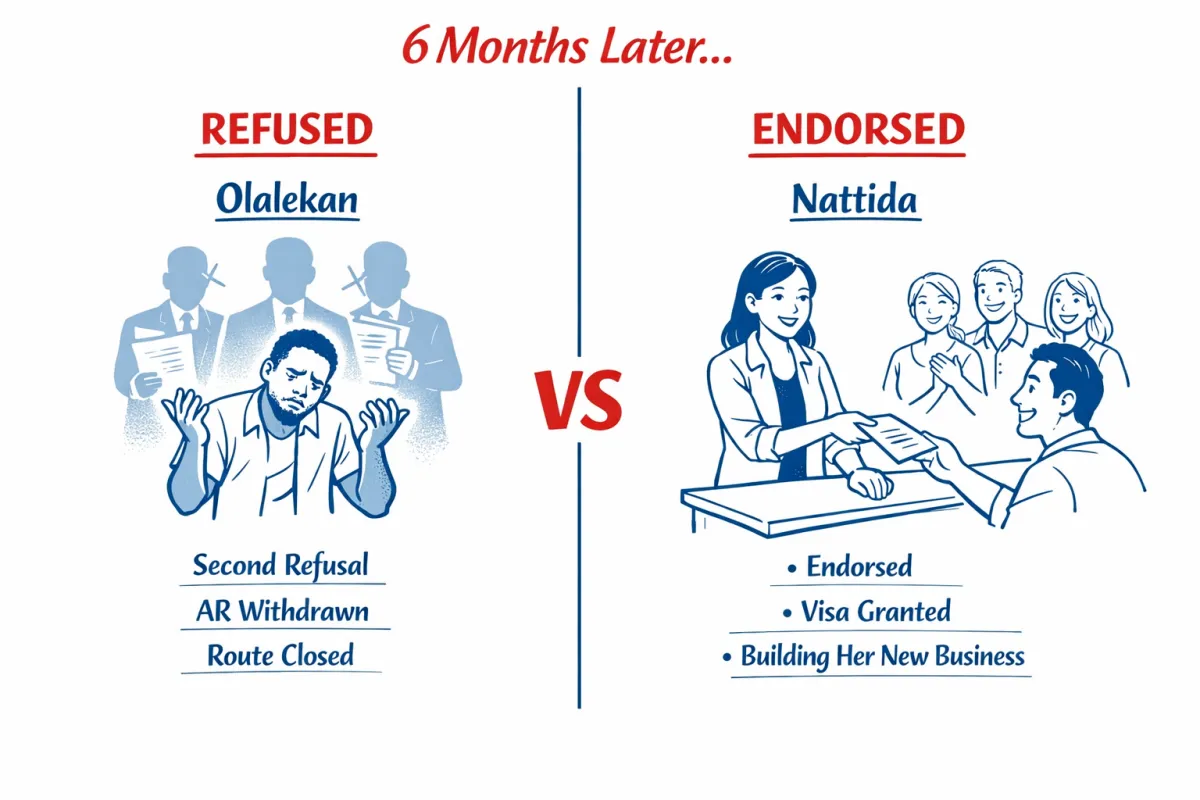
Both founders used the AR waiting period to begin the new business. Only one used the time to build it differently.
There is a way of starting a new business that makes your situation much worse. Most founders do not realise this until they are already in it.
When your extension was refused, your immigration leave was placed on what is called Section 3C leave. This means you are allowed to stay in the UK while your AR is pending. Your leave continues automatically.
Section 3C leave ends on the date of the AR decision. Not in 14 days after you receive the letter. On the date the decision is made.
If your AR has already been decided against you, your Section 3C leave has ended. The Immigration Rules include a provision called Paragraph 39E. This may allow a short period of overstay to be disregarded if you make a new application promptly. This is not a grace period. It applies to specific circumstances. Your immigration solicitor must assess whether it applies to your situation.
A second endorsement refusal, in this position, is not the same as the first. It means a visa application has been refused. There may be an overstay in your immigration history. There is now a second refusal on record. The options available at that point are much fewer than the options you have now.
The founders who navigate this successfully understand two things at the same time. First, the AR waiting period is preparation time, not waiting time. Second, a second failure built on the same preparation as the first is likely to be the end of this route.
You cannot rush the work that produces a strong endorsement application. But you can structure it so that every month builds toward the submission.
The New Business Coaching Programme runs for six months. This is how long the validation work takes when done correctly. Each phase depends on what the previous phase produced. The timeline is not a commercial decision.
Months 1–2: Problem and customer validation
The programme begins with a problem, not a business idea.
A Lean Canvas is a one-page tool that maps the key parts of a business model: the problem, the customer, the solution, the revenue, the costs, and the competitive advantage. You will build five or more versions of the Lean Canvas during this phase. Each version is tested against what real customers tell you. Each version changes based on what you find.
This is the phase that the original preparation either skipped or shortened. It is also the phase that determines whether the business plan you eventually submit can be defended in an interview. Every assumption in that plan will have been either confirmed by customer evidence or clearly identified as still to be tested.
During this phase you will conduct fifty or more structured customer interviews. These interviews follow a methodology that separates real customer insight from polite agreement. They produce primary evidence of market need. No amount of desk research produces the same result.
By the end of month two, you have a business idea that has survived real contact with the market.
Months 3–4: Business model development
With a validated problem and a tested solution, the programme moves to building the full business model.
Competitive positioning is built from primary research — not from claims about being different. An intellectual property strategy is developed. Financial projections are built from what customers told you they would actually pay — not from market size estimates.
The founder-business model fit is also developed here. This means documenting why you specifically are the right person to build this business in the UK, based on your background, your experience, and your demonstrated access to the market.
Each of these outputs maps directly to what endorsing bodies assess. The competitive positioning answers the Innovation criterion. The financial model answers the Viability criterion — specifically the requirement for projections the founder can personally defend. The growth roadmap answers the Scalability criterion.
Months 5–6: Endorsement preparation
The final phase builds the application from the evidence base you have constructed.
The business plan is written with the endorsing body's assessment framework applied throughout. The endorsing body is selected based on real fit with your idea and your profile — not based on convenience.
Interview preparation in this phase is not memorising answers. It is the fluency that comes from having built the business yourself. You understand your market, your customer evidence, and your financial model well enough to explain each one under detailed questioning. For founders whose first application failed partly because the interview exposed a plan they had not built themselves, this phase directly addresses that failure.
Every founder that signs up for this programme before 31st May 2026, has an AI co-founder working with them between coaching sessions.

The programme includes access to LeanSpark.ai. This is the AI co-founder platform built by Ash Maurya - the creator of the Lean Canvas. The Lean Canvas methodology is used at MIT, Harvard, Y Combinator, and Techstars.
Credits to use the platform are provided through The Startup Race's allocation for your full programme duration.
LeanSpark is not a tool you use occasionally. It drives the validation work between coaching sessions. It retains a complete memory of your project - every canvas version, every change, every customer interview result, every experiment. It uses this memory to tell you what to do next. You do not need to explain your project again each time you open it. It knows exactly where you are in the process.
What LeanSpark does:
The 7-dimension business model assessment.
Every version of your Lean Canvas is scored across seven dimensions: Clarity, Desirability, Viability, Feasibility, Defensibility, Timing, and Mission. Each is rated from 0 to 10.
These dimensions are directly connected to the endorsement criteria. Desirability maps to the Innovation criterion's requirement for demonstrated market need. Feasibility and Viability map to the founder capability and financial evidence that the Viability criterion requires. Defensibility maps to the competitive advantage that endorsing body reviewers specifically test.
Running this assessment after every canvas version shows you (before you speak to a reviewer) where your application is weak. You can address those weaknesses before they become problems in the interview.
Structured customer interview guides.
Not knowing what to ask is one of the most common problems for founders approaching an unfamiliar market. LeanSpark generates a structured interview guide for your specific hypothesis. It tells you who to speak to, which questions will produce real insight, and which questions will produce polite but useless answers.
For founders who are approaching a UK market they are still learning (or conducting interviews in English as a second language) having precise, structured questions removes significant cognitive load. You are not trying to think of the right question in real time. You already have it.
LeanSpark cannot find contacts for you. The programme teaches you the method for customer outreach - including cold outreach to people you do not yet know, through LinkedIn, professional associations, and industry forums. The methodology makes that outreach more focused and more productive. It does not provide contacts.
Interview transcript analysis.
After each customer conversation, you paste the notes or transcript into LeanSpark. It identifies patterns across multiple conversations. It shows you which insights are validated by more than one customer and which are contradicted. It tells you what the evidence supports - and what it does not yet support.
These validated insights become the primary evidence base for your endorsement application. They also give you specific, evidenced answers to interview questions about your customers - rather than general statements about market categories.
90-day sprint cycles.
The validation work runs in structured two-week sprints inside 90-day cycles. Each sprint has defined tasks, defined success measures, and a defined decision point: continue, change direction, or stop.
This structure converts your validation activity into a systematic, documented evidence record that an endorsing body reviewer can assess. It also creates accountability between sessions. The sprint plan commits you to specific actions before the next coaching call. It ensures the work happens in the weeks between sessions, not just during them.
Complete project memory.
Every canvas version, every sprint result, every decision to change direction is saved and connected across the six months. When you reach the endorsement application, your LeanSpark workspace is a complete record of how the business was developed — from the first hypothesis through to the validated model.
This record is not just useful. It is itself evidence of the kind of careful, founder-led development that endorsing bodies are designed to reward.
For founders building in a second language and in an unfamiliar market:
The endorsement process requires you to explain your business idea clearly, in English, and to defend it under detailed questions. You must be able to say what makes your idea genuinely new, why you are the right person to build it, and why the market evidence supports your financial projections.
LeanSpark's structured outputs (the scored canvas, the validated interview insights, the experiment results) give you both the structure and the vocabulary for this. You are not starting from nothing. You are explaining evidence that the platform has already helped you organise, using the clear language that reviewers are trained to assess.
There is also a more fundamental benefit for founders whose business education pointed them toward comprehensive planning rather than iterative testing. LeanSpark explains why the UK endorsement process rewards customer evidence over detailed planning. It does not just tell you what to do. It explains why this approach is what the assessment is actually testing.
For founders who have spent their professional careers demonstrating seriousness through careful planning, this explanation matters as much as the practical steps. The methodology is not a rejection of rigour. It is a different kind of rigour — one based on evidence from real customers rather than carefully built assumptions.
The New Business Coaching Programme includes:
12 × 60-minute one-to-one coaching sessions over 6 months, every two weeks
Full access to LeanSpark.ai - the AI co-founder platform that drives the validation work between sessions. Credits provided through The Startup Race's allocation. Included in the programme fee.
Full access to LivePlan for financial modelling - used to build and test your financial projections in months 3–4. Included in the programme fee.
Async support between sessions: detailed responses to questions that arise from the work, within 48 hours. This is used for reviewing a Lean Canvas revision, checking customer interview findings, or testing an assumption in your financial model.
Endorsing body selection guidance - based on direct knowledge of how all four active endorsing bodies assess applications, which sectors they prefer, and what their interview style is.
Business plan review against the actual endorsement assessment standard - including a specific check for the same weaknesses that produced the original refusal.
Interview preparation built around how endorsing body reviewers actually conduct assessments, with specific attention to the questions that exposed weaknesses in the original application.
This is not a business plan writing service.
The work in this programme is yours - the customer interviews, the validation sprints, the competitive analysis, the financial modelling. The coaching sessions and the AI co-founder direct the work, challenge your assumptions, and help you calibrate your evidence. Neither produces documents for you.
This matters with particular force for founders who used a consultant for the original application.
Using a consultant to write a business plan is a rational response when you identify a gap in your language, your knowledge, or your understanding of what is required. Many founders in this position did exactly that. The consultant produced a professional, well-structured document.
The endorsement interview then revealed the problem.
Every financial assumption in the plan, every customer insight, every decision about competitive positioning must be defended by you - speaking in real time, under detailed questioning. A plan written by someone else fails under the first serious question. Not because the ideas in it are wrong. Because you are defending a document, and you cannot defend it the same way you defend something you built yourself.
The programme does not take work away from you. It builds your ability to do the work that the endorsement process actually assesses. A business plan that results from six months of real validation is completely different from one written to a brief. Experienced reviewers can identify the difference within the first two pages.
This is also not immigration legal advice. The programme does not advise on your immigration status, your Section 3C leave position, your AR, or your visa application.
The decision about when to submit a new visa application (whether to wait for the AR result or to proceed before it) must be made with your immigration solicitor. The business development work belongs to this programme. The immigration decisions belong to your solicitor.
We reviewed over 1,100 applications from inside an endorsing body. We know what the difference looks like.
We reviewed applications for a Home Office-approved endorsing body. Over 1,100 applications in total. Seventy-six were endorsed.
We know what a strong application looks like. We know what a weak one looks like. And we know the specific patterns that produce each outcome.
We have reviewed applications from founders who were well-qualified and genuinely committed to this route - but who built their businesses using planning methods that are considered rigorous in many countries and are simply not what endorsing bodies assess.
We have reviewed applications where the founder was clearly defending a document written by a consultant. These are not difficult to identify. The interview exposes them within minutes.
We have reviewed applications where the milestone failures that caused the extension refusal were a direct and predictable result of a business plan built on projected assumptions rather than validated evidence.
The gap between those applications and the ones built through real customer validation is visible immediately. That gap is what most endorsement rejections, and most extension refusals, are actually measuring.
The methodology this programme is built on (Lean Canvas problem and solution validation, structured customer discovery, competitive positioning from primary research, LivePlan financial modelling) is the same process we required our endorsed applicants to work through. It produced a 95% endorsement success rate.
It takes six months because the endorsement process is designed to assess whether a founder has done this work - not whether they can describe it.
A founder in your situation (with real consequences, a defined and shrinking timeline, and a genuine commitment to getting this right) deserves preparation that matches what you are actually facing.
This programme is built for immigrant founders like you.
The pattern of Upgrade/Extension refusals and AR failures that brings founders to this page is concentrated in this population. Not because immigrant founders lack capability. But because the endorsement process tests a methodology that most business education programmes outside the UK and US do not teach.
That is the gap this programme addresses.
This is right for you if:
Your Innovator or Innovator Founder visa upgrade or extension application has been refused, and you have applied for or are preparing to apply for an Administrative Review
Or - your AR has been decided against you, and you have received specialist legal advice confirming that Judicial Review is not viable for your case
You have taken specialist immigration advice on your current status - or are in the process of doing so
You understand that a second endorsement failure, in your current immigration position, is much more serious than the first
You are prepared to commit six months of serious work to building a business through evidence and customer validation - not to producing a plan that describes one
You can identify UK customers, professionals, or industry contacts to interview - or you have a realistic plan for reaching them through cold outreach
Consider something else if:
You have not yet taken specialist immigration advice on your current status - this step comes before this programme and before anything else
A specialist immigration barrister has reviewed your case and identified specific, arguable legal grounds for Judicial Review - a pre-action protocol letter is the right first step in that situation
You want a consultant to produce the business plan and manage the endorsement application for you — this programme does not do that, and a consultant who does will not prepare you for the interview that follows
You are looking for a programme that can be completed in less than six months - the timeline reflects the validation methodology, not a commercial choice
You have no access to UK customers, professionals, or industry contacts, and no realistic way of reaching any - this is worth discussing before enrolling
New Business Coaching Programme:
£2,997 until 31 May 2026, £3,997 after that. Payment options available
Six months of structured business development. Built on the lean validation methodology that produced a 95% endorsement success rate. Twelve sessions, every two weeks. LeanSpark.ai and LivePlan included. Async support throughout.
If your AR is still pending, the programme can begin now.
The business development work does not affect your AR. An endorsement application to one of the four approved endorsing bodies is not a visa application. It does not withdraw a pending AR. The decision about when to submit a visa application (and whether to wait for the AR outcome) is a decision you make with your immigration solicitor, when the endorsement letter is received.
This programme builds the business that justifies that letter.
It does not promise endorsement. It builds the preparation that gives you the strongest possible case - and that directly addresses the documented root causes of why the original application failed.
What does £2,997 sit against?
A Judicial Review challenge costs between £15,000 and £40,000 in legal fees. This assumes your case has arguable legal grounds. Most extension refusals do not produce arguable grounds. The legal fees are spent regardless of the outcome.
A second endorsement refusal (made without addressing the root causes of the first) is not just an additional cost. In your current immigration position, it may end your access to this route entirely.
The programme includes: six months of one-to-one coaching, full access to LeanSpark.ai for the full programme duration (this costs approximately £80 per month if purchased independently — around £480 over six months), and full access to LivePlan for financial modelling (this costs approximately £32 per month if purchased independently — around £190 over six months). Both platforms are included in the programme fee.
The relevant comparison is not between this programme and a cheaper preparation option. It is between structured preparation that addresses why the original business failed - and the cost of not doing that.
Click on the button above to schedule a free 30-minute call
An honest conversation about where you stand, what your options are, and whether this programme is the right fit for your situation.
Freqently Asked Questions:
Can I start this programme while my AR is still pending?
Yes - but you need to understand an important legal distinction first.
The Administrative Review is automatically withdrawn if you submit a new visa application to UK Visas and Immigration. This is stated in Paragraph AR 4.4 of the Immigration Rules.
But a visa application to UKVI and an endorsement application to a private endorsing body are different things. Applying to one of the four approved endorsing bodies (such as Innovator International or UK Endorsing Services) does not trigger AR 4.4. Your AR continues.
This means: you can begin the programme and apply for an endorsement while your AR is running. When the endorsement letter arrives, you have a three-month window and a decision to make. You can wait for the AR result, or you can submit the new visa application, which withdraws the AR. This decision requires specialist immigration advice based on your specific circumstances.
What the programme ensures is that when you reach that decision, the new business is properly prepared.
I haven't taken immigration advice yet. Can I still apply?
Not yet. Taking specialist immigration advice on your current status is the first step — before this programme and before anything else. Your Section 3C leave ends on the date of the AR decision. The implications of this depend on your specific situation and must be assessed by a specialist solicitor. Once you have that advice, we can talk.
Should I be pursuing Judicial Review instead of starting a new business?
This depends on why your extension was refused.
If a specialist immigration barrister has reviewed your refusal and AR decision and identified specific, arguable legal grounds — such as a caseworking error, the wrong rules applied, or a clearly wrong finding of fact — then a pre-action protocol letter is the right first step. This programme is not the right first step in that situation.
If the refusal was based on genuine problems with the business — insufficient progress against the plan, inadequate trading evidence, or an interview that exposed a plan the founder could not defend — those are not caseworker mistakes. Judicial Review will not fix them. This programme addresses those problems directly.
The key question is whether there are genuine, arguable legal grounds. Only a specialist barrister can answer that. Not an endorsement preparation service.
What happens to my settlement timeline if I start a new business?
Time counted toward the 3-year ILR qualifying period under your previous Innovator or Innovator Founder visa is tied to the same business. A completely new business on a new visa resets this qualifying period. If you had significant time already counted, this is a real cost. Your immigration solicitor should explain the full implications before you commit to this path.
Can I do this while pursuing Judicial Review at the same time?
In principle, yes. In practice, running a Judicial Review and making a new visa application at the same time is legally complex. A new visa application can interact with the JR in ways that require specialist advice. If you are considering both at the same time, your solicitor must know before you begin either.
How are sessions delivered?
By video call, typically Zoom. Session times are arranged after the initial intake conversation, built around your schedule and the programme phases.
What does async support include?
Detailed responses to questions that arise from the work between sessions. Examples: reviewing a new version of the Lean Canvas, checking customer interview findings, or testing an assumption in your financial model.
It is not a 24/7 helpdesk. In practice it is used for the work that comes out of the sessions and needs a response before the next one. Responses within 48 hours.
What is LeanSpark.ai and how does it fit into the programme?
LeanSpark.ai is the AI co-founder platform built by Ash Maurya — the creator of the Lean Canvas. It is the platform where the validation work between coaching sessions runs. It retains a complete memory of your project across the six months. It generates structured customer interview guides. It analyses interview transcripts to identify validated insights. It scores your business model across seven dimensions. It plans your validation sprints.
Think of it as structured coaching that runs between sessions, calibrated to exactly where you are in the process. Credits are provided through The Startup Race's allocation for the full programme duration.
I am not familiar with lean startup methodology. Will this be a problem?
No. And understanding why not is important.
Lean startup methodology is a business development approach developed in Silicon Valley. It is widely taught in UK and US accelerators. It is not widely taught elsewhere. Most of the endorsed applications I reviewed were built by founders who had internalised this approach. Most of the rejected applications were built by founders who had not.
The coaching sessions introduce the methodology as part of the programme. LeanSpark reinforces it conversationally — explaining what each step requires and why.
More importantly: LeanSpark explains why the UK endorsement process rewards evidence from customer conversations over detailed planning. For founders whose training equates thoroughness with rigour, this explanation is as important as the practical steps. The methodology is not less rigorous than comprehensive planning. It is a different kind of rigour — one built on evidence from real customers rather than carefully constructed projections.
My original business plan was written by a consultant. How does this affect the new build?
This is a relevant part of understanding why the original application failed. Naming it honestly is more useful than avoiding it.
Consultant-written plans that the founder cannot defend in interview are one of the most common patterns in extension refusals and endorsement rejections for this population. The programme is specifically designed so that the founder builds the new business from first principles. Every assumption in the new business plan will have come from your own customer conversations, your own analysis, and your own decisions.
This is not a harder standard. It is the only preparation that works for the interview that follows.
I will be conducting customer interviews in English, which is not my first language. Is this a problem?
This is a real constraint. The programme is designed to work within it.
LeanSpark generates structured interview guides that tell you exactly what to ask and why. You are not trying to think of the right question in real time in a second language. You already have the questions, prepared and structured before each interview.
LeanSpark's transcript analysis then processes your notes or recordings from each conversation. It identifies patterns and validated insights across multiple interviews — including insights that are easy to miss when working in a second language.
The coaching sessions can also be used to review customer conversations directly — what you heard, what it means, and what it changes in your canvas.
I do not have any UK professional contacts. How do I find people to interview?
This is the right question to ask before enrolling.
The programme teaches structured cold outreach. This means approaching potential customers you do not yet know — through LinkedIn, industry associations, professional forums, and direct messages — using a specific hypothesis and a short, focused explanation of why the conversation would be worth their time.
The methodology improves both the quality of the outreach and the quality of the conversations it produces. The programme does not provide a contact list or make introductions.
If you have no route at all to reaching UK customers or professionals in your target market — no LinkedIn presence, no professional context for outreach, no industry communities you can access — this is worth discussing in the free 30-minute call before you enrol. For most founders, the barrier is the methodology, not the access. But for some, the access problem needs to be addressed first. An honest conversation about this before enrolling is more useful than discovering it halfway through the programme.
What if my new idea does not survive the validation process?
This is the right outcome if the idea does not hold up under testing.
A business concept that fails at customer validation fails more quickly — and at much lower cost — inside the programme than it would at endorsement. The programme is designed to find this early, not to avoid it. Most founders test and change their idea several times in the first two months before arriving at the version they build.
LeanSpark's sprint structure moves you through this process efficiently, with clear evidence at each decision point. For founders in your immigration position, finding that an idea does not work in month two is manageable. Finding it at endorsement — or at a second extension — is not.
Can you guarantee I will be endorsed?
No. Anyone who offers this guarantee is not being honest with you.
What this programme guarantees is that the preparation you complete will be built to the actual standard that endorsing bodies apply. It will be based on real validation evidence. It will be tested in the way reviewers test it. And it will be presented with the confidence that comes from having built the business yourself — not from having received a document.
It also guarantees that the root causes documented on this page — the methodology gap, the knowledge gap, the delegation problem — are directly addressed in the preparation, rather than repeated in a new application.
© Copyright The Startup Race 2026