Refused Innovator Founder Endorsement?
Your Innovator Founder endorsement refusal letter is twelve pages long.
The decision is in about six sentences.
Most of your refusal letter is kind. It repeats your plan back to you, says your idea is "a foundation", and finds something nice to say in every section.
Then you look at the scores at the end, and there's a 2.
Kind words don't change a 2, because it means your application failed.
But here's the part nobody tells you. Somebody read your plan very closely and wrote down what was missing. You paid £1,000 for that letter. Let's get your money's worth.
Send me your refusal letter. I'll show you which six sentences decided it, what the kind words really scored, and what's missing.
It's free, and it comes back to you in writing.
Upload your Innovator Founder Endorsement Refusal Letter and answer the questions on this form to receive your free read within five working days.

Not ready to send your letter yet? Book a free call instead.
What does our free read of your letter reveal?
Your letter scores six areas of your business from 0 to 6. You need at least 3 in every area to pass.
One 2 is enough to fail.
Here's part of a read for an example we made up:
| What the letter says | Score |
|---|---|
| "a strong understanding" | 3 (a pass) |
| "a foundation for the business" | 2 (a fail) |
| "key task headlines" (a list of tasks, with no detail) | 2 (a fail) |
| "initial assumptions appear to be reasonable" | 2 (a fail) |
If one of those sentences looks familiar, you're not alone. They come from real letters.
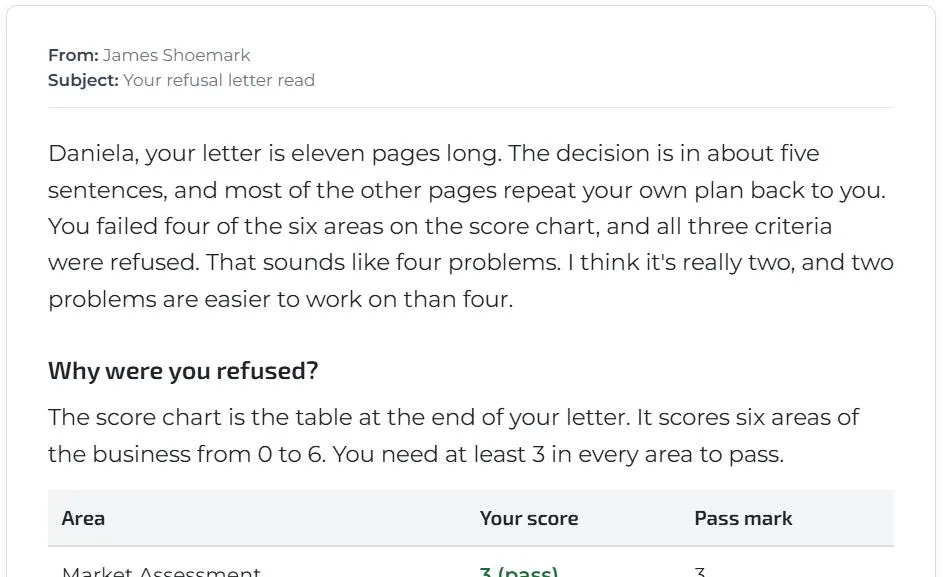
Your read gives you the lines that decided your refusal, in plain words. It joins the failed areas into the one to three real problems behind them. It tells you what a pass looks like in each area.
And it ends with a short list of what's missing, with an honest guess at how long each piece takes.
What kind of problem do you have?
This question decides what you should do next, and most founders never ask it.
There are three kinds of problem, and they come in an order. Your letter can only see two of them.
The first is your Founder/Business Model Fit, and no letter can see it. A suit can be well made and still be the wrong size for you. Some businesses are like that. Picture a brilliant engineer who hates talking to strangers, with a plan that depends on selling face to face. Or someone who wants a small, calm business they control, with a plan that needs investors and 50 staff. On paper, the plan looks fine. But every day, the business asks the founder to do the thing they least want to do. It comes first, because the other two depend on it.
So our letter upload form asks a few short questions about you. I don't mark your answers. They help me read your letter properly.
The second is the innovation in your idea. The assessor (the person who scored your plan) names five companies that already sell what you sell. Or nobody has shown yet that customers want it. Picture a shop window full of the same things as the shop next door. A better-written plan won't change what's in the window. You need to decide first: find a real difference inside this idea, or change it. Then customers have to show that the difference matters to them.
The third is the credibility of your evidence. The proof exists, and your plan didn't show it. You have customers, and the sales plan has no names in it. You know your costs, and the forecast uses guesses. Gathering what you have, and writing it so a stranger can check it, fixes this. A new business doesn't.
Sometimes there's a fourth. The assessor missed something you sent. My read checks for that first.
Here's the hopeful part. A letter can fail four or five areas and still come down to one or two problems. My read tells you which one to start with. And a problem with a name is a problem you can work on.
How does it work?
Tonight, you fill in the short form above and upload your letter. It takes about ten minutes. Some questions ask what you want from the business. Rough answers are fine.
Within five working days, your read arrives by email. I check every word myself before it goes out. If I've had a lot of letters that week, I'll tell you the date yours will arrive.
The read ends by asking you for one sentence: your first step, and the day you'll take it. Writing it down makes it more likely to happen. A week later, I'll ask how it went.
Then, if you'd like, we can talk it through for 30 minutes by video call, at a time that suits you. That's free too. I'll ask what the last few weeks have been like. You ask me anything you like about the read.
That's it. Most people just take the read and get on with it. If you'd like help afterwards, I'll tell you what that looks like, once. Then it's up to you.
Questions people ask before they send a letter
Why is it free? Two reasons. Most refused founders need to understand their letter more than they need a programme. And I run my business the way I teach founders to run theirs. I ask my customers what they need, I listen, and I change the service when they show me something better. Your answers and our call help me do that. I keep what I learn. I never keep your letter for that, and I never share it.
Is my letter safe? Yes. It's private. I use it only to prepare your read, and I never share it. I delete it after 12 months, or sooner if you ask.
Do you use AI? Yes, to help me prepare the read, and then I check every word. The form asks you to agree to that.
Will you contact the Home Office or the endorsing body? No. This is between you and me.
Which letters can you read? Refusal letters from Innovator International, UK Endorsing Services and Envestors. If the Home Office refused your visa itself, that's a different letter, and it's a question for a regulated adviser.
Can I just email you instead? Yes. Write to [email protected] and I'll reply myself.
My English isn't perfect. Does that matter? Not at all. Answer in your own words. Your read comes in plain English with short sentences, so it works well in a translator too.
Do I have to buy anything? No. The read is yours to keep, whatever you decide.
Who we are
I'm James Shoemark, CEO at The Startup Race. We help founders build businesses that work. Reading refusal letters is one of the things we do. We've worked with founders since 2010, and spent most of that time telling them things they didn't want to hear.
From 2020 to April 2023, The Startup Race was an endorsing body for the Start-up and Innovator visas. We read applications, wrote decisions, and refused many of them. We also sat in the follow-up meetings where an endorsed plan is checked against what really happened. So we've read letters like yours from the other side of the table.
Here's what that looks like. 1,134 founders joined our programmes, and every one had free access to LeanStack, a toolkit for testing whether a business idea works. Fewer than 1 in 10 proved they were ready for our accelerator. Some of the others were paying up to £10,000 a year. They still didn't meet the standard, so I said no.
That's why you'll get an honest read. It's the only kind we know how to give.
What we don't do
We don't write your plan. An assessor can tell a plan you wrote from one written for you. And you'll have to defend every number in it.
We don't promise endorsement. Nobody honest can.
We don't give immigration advice. For questions about your visa, administrative review or your status, please speak to a regulated adviser. You can find one on the Immigration Advice Authority's Find an immigration adviser page, or through the Law Society's Find a Solicitor.
Check out our free guide: "After a refusal: your options, explained".
What you'll get, and what you won't
You'll get
- The sentences that decided your refusal, in plain words.
- What the kind words really scored, and what's already working.
- The one to three real problems, and what kind each one is: a Founder/Business Model Fit problem, an idea problem or a credibility problem.
- Which problem to start with, your first steps for this week, and a short list of what's missing.
You won't get
- A guess at your chances. Nobody honest can give you one.
- A new plan written for you.
- Advice about your visa, appeals, or which endorsing body to use.
- A sales pitch.
It's short, on purpose. Your letter is long. The decision isn't.
Ready when you are
Your letter has already done the hard part. It's written down what's missing. Let's find out what it means.
Founders The Startup Race has endorsed in the past should contact us directly, not through this form.
The Startup Race Ltd is not accepting new applicants for visa endorsement.
The Endorsement Readiness Programme is education and coaching. It is not an endorsement.
We are not regulated by the Immigration Advice Authority and we do not give immigration advice.
For advice about your visa or immigration status, please speak to a regulated immigration adviser or solicitor.
The Startup Race Ltd. Registered in Scotland, company number SC536976.
Registered office: Orchard Brae House, 30 Queensferry Road, Edinburgh, EH4 2HS.
© Copyright The Startup Race 2026 | Finding Neos Since 2016